
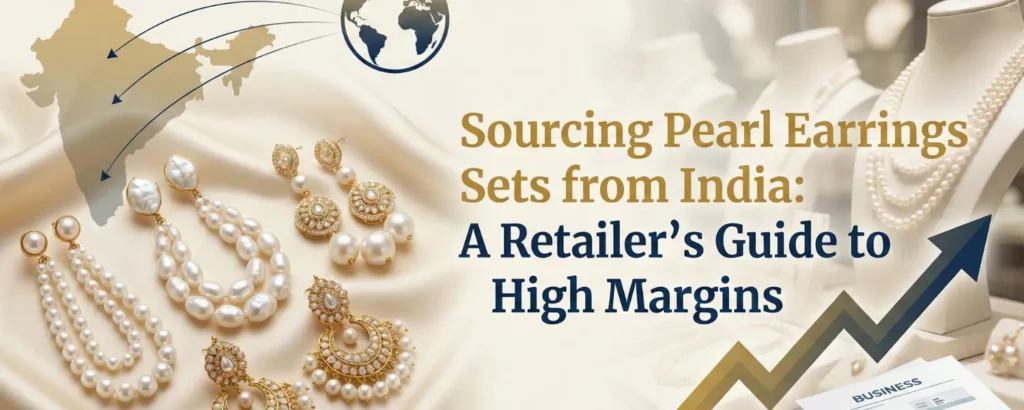
In the high-stakes world of jewelry retail, the margin is everything. As we approach 2026, savvy retailers and wholesalers are looking beyond standard suppliers to find inventory that offers both exceptional quality and significant profit potential. The answer increasingly points to one destination: India. Specifically, the market for pearl earrings sets—often comprising matching necklaces and earrings or curated earring collections—is booming.
For global importers, India offers a unique “trifecta” of benefits: access to diverse pearl varieties, world-renowned handcrafted artistry, and production costs that allow for healthy markups. If you are looking to elevate your inventory with high-demand pearl earrings sets, sourcing from India is your most profitable strategy. Here is your guide to navigating this lucrative market.
The Indian Advantage: Why Sourcing Here Boosts Your Bottom Line
The primary reason to source from India is the unparalleled value proposition. While countries like China dominate the mass-produced freshwater market, India is the undisputed leader in handcrafted Indian designs that incorporate pearls.
Lower Labor Costs, Higher Artistry: India’s jewelry manufacturing sector benefits from lower skilled labor costs compared to Europe or the US. This means you can source intricate, labor-intensive designs—such as pearls set in Kundan, Jadau, or gold-plated brass—at a fraction of the cost of Western production.
Direct Access to Gemstone Hubs: Cities like Jaipur and Hyderabad are global hubs for gemstone cutting and pearl trading. Sourcing directly from Indian exporters cuts out multiple middlemen, allowing you to secure wholesale pearl earrings sets at near-factory prices.
High-Perceived Value: Indian pearl sets often feature elaborate metalwork, semi-precious stones, and gold plating. These elements increase the perceived value of the product for your end customer, allowing you to command higher retail prices while keeping your sourcing costs low.
Exploring the Variety: Freshwater vs. South Sea & Beyond
A major advantage of working with an Indian exporter is the sheer variety of inventory available under one roof. You are not limited to a single type of pearl.
Freshwater Pearl Sets: The bread and butter of the volume retailer. These are affordable, durable, and come in a myriad of shapes (oval, rice, button). Indian artisans excel at weaving these into multi-strand necklaces with matching earrings, perfect for the mid-range fashion market.
South Sea & Baroque Options: For high-end boutiques, sourcing South Sea or large Baroque pearl sets from India can be a game-changer. Indian designers are currently favoring these irregular, organic shapes, pairing them with minimalist gold settings to appeal to modern Western aesthetics.
Polki & Pearl Fusions: This is a high-margin niche. Uncut diamonds (Polki) paired with pearls create a regal look that is trending massively for weddings. These sets are unique to India and offer virtually no direct competition in Western local markets.
Navigating Trends: What to Stock for 2025/2026
To maximize turnover, your inventory must align with consumer demand. Current data suggests a shift away from simple studs toward statement pieces.
The “Statement” Bridal Set: Modern brides are looking for pearl earrings sets that serve as the focal point of their attire. Stock sets that feature chandelier earrings paired with chokers.
Mixed Metal Styles: Pearls mixed with oxidized silver or dual-tone gold/rhodium finishes are gaining traction. These offer a contemporary edge that appeals to younger demographics.
Convertible Jewelry: Look for Indian suppliers offering modular sets, where heavy earrings can be detached to form simpler studs. This functional versatility is a huge selling point for practical customers.
Quality Control: The Exporter’s Checklist
Sourcing internationally requires diligence. To ensure you receive saleable goods, your quality control process should be rigorous.
Check the Luster: The value of a pearl is in its glow. Even for fashion jewelry, avoid pearls that look chalky or dull.
Inspect the Setting: In handcrafted Indian designs, pearls are often glued or wired. Ensure that glue is not visible and that wire wrapping is tight and secure.
Matching Consistency: In a “set,” uniformity is key. The pearls in the earrings must match the tone and size of the pearls in the necklace. A mismatch here screams “low quality” to your customer.
Plating Durability: If buying gold-plated sets, insist on a minimum micron thickness (e.g., 1 micron) or “e-coating” to prevent tarnish during shipping and display.
Logistics: Smooth Sourcing from Order to Delivery
Successful importing relies on logistics. Most established Indian exporters are well-versed in shipping to the US, UK, and Europe.
MOQs (Minimum Order Quantities): Indian suppliers are often flexible. You can frequently find MOQs as low as 10-20 pieces per design, allowing you to test a variety of styles without overcommitting capital.
Documentation: Ensure your supplier provides a clear Commercial Invoice and Certificate of Origin. This is crucial for clearing customs smoothly and benefiting from any trade agreements your country may have with India.
By leveraging the cost advantages and artistic superiority of the Indian market, you can build a collection of pearl earrings sets that not only captivates your customers but also delivers the high margins your business needs to thrive.
Frequently Asked Questions (FAQs)
1. Why are Indian pearl earrings sets considered high-margin products?
Indian sets often combine affordable raw materials (like freshwater pearls and brass) with high-value craftsmanship. This creates a product that looks expensive and luxurious (high perceived value) but costs relatively little to produce, allowing retailers to apply a healthy markup.
2. What is the difference between Freshwater and South Sea pearls for retailers?
Freshwater pearls are abundant, durable, and budget-friendly, making them ideal for fashion jewelry and volume sales. South Sea pearls are rarer, larger, and more lustrous, commanding a luxury price point suitable for high-end boutiques.
3. Do Indian suppliers offer custom packaging for private label brands?
Yes, most reputable Indian exporters offer private labeling services. They can package your pearl earrings sets in custom branded boxes or cards, making them retail-ready upon arrival.
4. What are the current trends in Indian pearl jewelry for export?
Key trends include “Baroque” (irregular) pearls for a modern look, fusion styles mixing pearls with Polki (uncut diamonds), and lightweight, office-appropriate sets that move away from heavy traditional designs.
5. How do I ensure the quality of pearls when buying online?
Always request high-resolution photos and videos under different lighting conditions. For bulk orders, buying a sample kit first is highly recommended to physically inspect the luster and build quality.
6. What is the typical lead time for wholesale pearl earrings sets from India?
Ready-to-ship stock can be dispatched in 2-5 days. However, for made-to-order or custom designs, the production lead time is typically 3-5 weeks depending on the complexity of the handwork.
7. Can I import pearl sets that contain other gemstones?
Absolutely. India is a hub for colored gemstones. You can easily find sets combining pearls with semi-precious stones like emeralds, rubies, or synthetic stones, often referred to as “Jadau” or “Navratna” styles.
8. Is there a minimum order quantity (MOQ) for sourcing from India?
It varies by supplier. Large factories may require 50-100 pieces per style, but many smaller, artisan-focused exporters are willing to work with MOQs as low as 10-20 pieces to help you build a diverse trial order.