
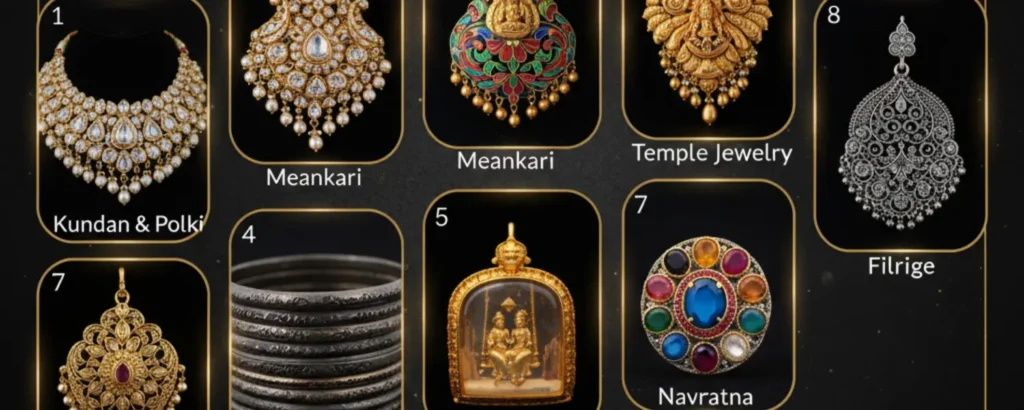
When you hear the term “handmade jewelry,” the mind conjures images of quality, uniqueness, and a human touch. Nowhere is this truer than in India, a land with an unbroken, millennia-old tradition of jewelry making. Handmade Indian jewelry is not just an accessory; it’s a piece of art, a slice of history, and a story told by the hands of a master craftsman.
For collectors, fashion enthusiasts, and retailers alike, understanding the diverse landscape of Indian craft is key to appreciating its true value. As a premier exporter, we live and breathe this artistry. Here is our guide to seven iconic types of traditional artisan jewelry from India that every connoisseur should know.
1. Kundan & Polki: The Royal Heritage
Perhaps the most iconic of all Indian jewelry, Kundan is a royal art form that originated in the Mughal courts. This technique involves setting uncut or rose-cut diamonds (known as “Polki”) and other gemstones into a highly refined and flexible 22k gold or 24k gold foil.
The stones are not set with prongs. Instead, a bed of gold foil is meticulously shaped around the gem, creating a piece that is opulent and radiates a soft, regal glow. Each piece is a masterpiece of precision and a true family heirloom.
2. Meenakari: The Art of Enamel
Where Kundan celebrates the front of a piece, Meenakari celebrates the back. This is the intricate art of painting and enameling metal surfaces with vibrant, jewel-toned colors. Originating from Jaipur, Rajasthan, artisans engrave intricate designs (often of birds, flowers, or paisleys) into the metal, which are then filled with colored enamel and fired in a kiln.
This process is repeated for each color, from most-heat-resistant to least. It’s a painstaking, multi-stage process that results in a design of breathtaking, permanent color. It is often found on the reverse side of Kundan jewelry, making the piece reversible and beautiful from every angle.
3. Temple Jewelry: The Divine South
Originating in the Chola dynasty to adorn the idols of gods and goddesses, Temple Jewelry is a major category of South Indian craftsmanship. As the name suggests, these pieces are bold, sculptural, and feature intricate motifs of deities, lotus flowers, swans, and mythological figures.
Traditionally made from gold and set with gems like rubies, emeralds, and pearls, these pieces were (and still are) worn by temple dancers (Bharatanatyam) and are a non-negotiable part of a South Indian bride’s trousseau. It is a divine art form that feels both ancient and powerful.
4. Oxidized Silver & Tribal Jewelry
In stark contrast to the opulence of gold, this category of handmade jewelry celebrates the rustic, earthy beauty of silver. Hailing from the nomadic and tribal regions of Gujarat, Rajasthan, and Himachal Pradesh, these pieces are bold, full of character, and deeply symbolic.
The silver is often oxidized (intentionally darkened) to highlight the intricate stamp work, engravings, and bells. This style, from heavy anklets (Payals) and necklaces (Haars) to statement earrings, is hugely popular in the global market for its bohemian, free-spirited aesthetic. Sourcing wholesale handmade jewelry from these artisan communities also supports an ethical jewelry ecosystem, preserving their craft.
5. Thewa: The Gold-on-Glass Secret
Thewa is a unique and secretive art form practiced by only a few artisan families in Rajasthan. It involves a “secret” process of fusing an intricately hand-carved, paper-thin 23k gold sheet onto molten colored glass. The designs are incredibly detailed, often depicting historical or mythological scenes.
Because it is so labor-intensive and its secrets are so closely guarded, Thewa jewelry is considered a rare and precious form of artisan jewelry. It offers a stunning, stained-glass-like effect that is unlike any other form of jewelry in the world.
6. Navratna: The Astrological Powerhouse
Navratna, or “nine gems,” is a specific type of jewelry that is deeply tied to Vedic astrology. It is a powerful talisman set with nine specific gemstones that represent the nine planets of the cosmos (Diamond, Ruby, Emerald, Yellow Sapphire, Blue Sapphire, Hessonite, Cat’s Eye, Pearl, and Red Coral).
When worn, the Navratna is believed to provide the wearer with balance, protection, and the positive energies of all nine planets. This category of handmade Indian jewelry is highly sought after by those who value both its beauty and its spiritual significance.
7. Filigree (Tarakasi): The Silver Lace
Tarakasi, or Filigree, is a delicate art form from Cuttack, Odisha. It is the art of “silver lace.” Master artisans take thin wires of silver (or gold) and twist, curl, and plait them into intricate, latticework designs.
The result is a piece of jewelry that is incredibly light, airy, and ethereally beautiful. It requires a tremendous amount of patience and precision. From delicate earrings to statement pendants, Filigree jewelry is a testament to the artisan’s steady hand and boundless creativity.
The Enduring Legacy of Indian Artisans
These seven styles are just a brief glimpse into the magnificent world of handmade Indian jewelry. Each piece is a testament to a craft perfected over centuries, a labor of love, and a direct link to a rich cultural heritage.
As an exporter of fine Indian jewelry, we are privileged to be the bridge between these master artisans and the global market. By choosing to source or wear these pieces, you are not just acquiring an ornament; you are becoming a custodian of a timeless art form.
Frequently Asked Questions (FAQs)
What is the main difference between Kundan and Polki jewelry?
Polki refers to the uncut diamond itself. Kundan is the technique of setting Polki and other gems into a gold foil base. They are often used together, as in “Kundan-set Polki jewelry.”
Is Meenakari jewelry durable?
Yes. Meenakari is a form of fired enamel, which is essentially powdered glass fused to metal. Once fired, the color is permanent, waterproof, and very durable, though it should be protected from sharp impacts.
What makes Temple Jewelry different from other types?
Its motifs. Temple jewelry is defined by its use of divine figures, gods, goddesses, mythical creatures, and sacred symbols (like the lotus or peacock), which are not the primary focus of other jewelry styles.
Is Oxidized Silver real silver?
Yes. Authentic oxidized jewelry is made from 925 sterling silver that has been intentionally darkened (oxidized) with a chemical, which is then polished to highlight the design. This finish is a surface treatment, not a different metal.
As a retailer, can I order wholesale handmade jewelry from India?
Absolutely. India is the world’s premier hub for wholesale handmade jewelry. Working with a reputable exporter allows you to source a diverse range of artisan jewelry—from tribal silver to fine Kundan—directly from artisan communities.
What is so special about Navratna jewelry?
Its power is in its completeness. Unlike wearing a single stone for a single planet, Navratna jewelry is believed to offer the balanced, protective, and beneficial energies of all nine planets in the Vedic system simultaneously.
Is Filigree (Tarakasi) jewelry very delicate?
While it looks like lace, it is surprisingly strong for its weight. The twisted silver wires and soldering create a robust structure. However, like any fine jewelry, it should be stored carefully to prevent snagging or crushing.
How should I care for handmade Indian jewelry?
The best practice is to store each piece in a soft cloth or a separate box to prevent scratching. Avoid direct contact with perfume, lotions, and harsh chemicals. For specific types like Kundan, avoid water entirely.