
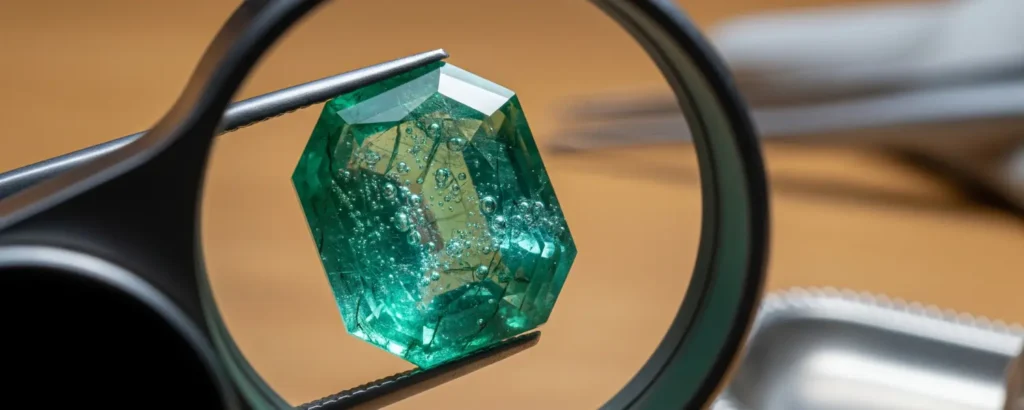
The emerald stone, with its captivating deep green hue, has been a symbol of power, love, and eternal spring for centuries. Known in Vedic astrology as the Panna stone, it is highly sought after for the powerful emerald benefits it is believed to bestow upon its wearer. However, as one of the world’s most precious gems, the market is unfortunately rife with fakes, synthetics, and heavily treated stones.
For a buyer making a significant investment, or for someone seeking the astrological blessings of the Mercury stone, authenticity is paramount. This expert guide will walk you through the key characteristics of a natural emerald stone, empowering you to make a confident and informed purchase.
Understanding What 'Natural' Truly Means
First, it’s important to define what we mean by “natural.” A natural emerald gemstone is a variety of the mineral beryl that has been mined from the earth. It was formed over millions of years under immense pressure. Famous sources, such as Colombian emeralds and their Zambian counterparts, are prized for their unique colour and quality. Crucially, a natural stone is almost never flawless. In fact, its imperfections are often the clearest proof of its authenticity.
Look for Inclusions: The Emerald's Natural 'Jardin'
The single most important characteristic to look for when identifying a natural emerald is the presence of inclusions. Unlike in diamonds, where inclusions are often seen as detractors, emerald inclusions are so common and characteristic that they have their own poetic name: “jardin” (the French word for garden).
Using a 10x jeweler’s loupe, examine the stone’s interior. A natural emerald will likely have a unique internal landscape of tiny fractures, fissures, crystals, or fibrous patterns. These are the stone’s natural birthmarks.
Red Flag: A completely “clean” stone with no inclusions whatsoever is highly suspect and very likely a synthetic lab-grown stone or a glass imitation. Glass fakes may also contain tiny, perfectly round air bubbles, which are not found in natural emeralds.
Analyzing the Color: Hue and Saturation Cues
The colour of a natural emerald is legendary for a reason. It should be a rich, vibrant green. The hue can range from a bluish-green to a yellowish-green, but the primary colour must be a distinct and vivid green.
Red Flag: Be wary of stones that have a dull, flat colour or appear too yellowish. While synthetics can mimic the colour, they often have an unnaturally uniform and overly saturated appearance that lacks the subtle depth and zoning found in natural gems.
The Sparkle Test: How Emeralds Refract Light
While brilliant, emeralds do not sparkle in the same fiery way a diamond does. A natural emerald has a softer, more velvety glow. It should appear bright from within, but it will not produce strong, rainbow-coloured flashes of light.
Red Flag: If you hold the stone up to a light source and it flashes with intense, rainbow-like fire, it is almost certainly an imitation like a green cubic zirconia, moissanite, or YAG.
Spotting Common Treatments and Imitations
It’s important to be aware of common practices used to alter or imitate emeralds.
Oiling: Most natural emeralds are treated with oils to fill surface-reaching fractures and improve clarity. This is a standard, accepted industry practice. However, stones that are heavily filled with coloured oils or resins are less valuable.
Dyeing: This is a deceptive practice where a low-quality, pale stone is dyed to appear a richer green.
Imitations: The most common fakes are green glass, green quartz, and tourmaline. Doublets or triplets are composite stones where a thin slice of real emerald is glued onto a base of glass or another less valuable mineral. You can sometimes spot these by examining the stone from the side for a visible glue line.
The Ultimate Proof: Insist on Professional Certification
While the tips above are invaluable, the only way to be 100% certain of an emerald’s authenticity and origin is through a certificate from a reputable, independent gemological laboratory. For any significant purchase, a certificate is non-negotiable. Reputable emerald exporters and dealers will always provide this documentation as proof of their product’s quality and authenticity.
By looking for the natural “jardin,” analyzing the unique colour and lustre, and above all, insisting on certification, you can navigate the market with confidence and find a genuine Panna stone that you will treasure for a lifetime.
Frequently Asked Questions (FAQs)
If a natural emerald has inclusions, does that significantly lower its value? Not necessarily. While extremely high clarity is valuable, the presence of the “jardin” is expected in emeralds. The value is more affected if the emerald inclusions are large, dark, and located in the center of the stone, or if they reach the surface and compromise its durability.
Are oil-treated emeralds considered “natural”? Yes. Oiling is a standard and accepted clarity enhancement for emeralds, and an oiled stone is still classified as a natural emerald. However, the seller must disclose the treatment, and the level of treatment (minor, moderate, significant) will affect the price.
Why are completely flawless emeralds so rare and often suspected of being fake? The geological conditions under which emeralds form are very turbulent, making the growth of large, clean crystals extremely rare. Therefore, a stone that appears perfectly flawless under magnification is statistically much more likely to be a lab-grown synthetic than a natural gem.
Can a local jeweler identify a natural emerald stone for me? An experienced local jeweler or certified gemologist can certainly help. They have the tools and expertise to examine the stone’s inclusions, refractive index, and other properties to give you a reliable assessment.
What is the main difference between Colombian and Zambian emeralds? Colombian emeralds are famed for their warm, intense, pure green colour. Zambian emeralds, a major source of high-quality stones, are known for their slightly bluish-green hue and often have higher clarity than their Colombian counterparts.
Is the Panna stone the same as the Mercury stone in astrology? Yes. In Vedic astrology, the Panna stone is the primary gemstone for the planet Mercury (Budh). It is worn to enhance Mercury’s positive qualities, such as intellect, communication, and business acumen.
Does the Zambian emerald price differ greatly from the Colombian price? Generally, top-quality Colombian emeralds command the highest prices due to their legendary status and unique colour. However, a high-quality Zambian emerald can be more valuable than a mid-quality Colombian stone. The Zambian emerald price offers excellent value for a top-tier gem.
For astrological purposes, who can wear Panna for the best results? The question of who can wear Panna is best answered by a qualified Vedic astrologer. It is typically recommended for individuals with Gemini (Mithuna) or Virgo (Kanya) zodiac signs, or for those who have a favorably placed Mercury in their birth chart.